

AI clinical and wellness simulation
Practise on a real patient, before a real patient is ever at risk.
VR Patients is an AI-driven medical simulation platform that lets nursing and EMS teams assess, treat and, crucially, talk with a lifelike virtual patient. Supplied through SkillsTrain on a subscription, per seat. You can use a VR headset, but you do not have to. It also runs in an ordinary web browser.
Watch the one-minute overview
See a virtual patient in action
A short overview from VR Patients showing how a trainee assesses, treats and talks with a lifelike virtual patient, and how an instructor builds and grades a scenario. SkillsTrain supplies VR Patients across South Africa and Southern Africa.
A flight simulator for clinical care
What VR Patients is, in plain terms
Think of VR Patients as a flight simulator for clinical care. Instead of practising on a mannequin that cannot talk back, or waiting for the right real case to walk through the door, your trainees run through realistic patient encounters as often as they need to.
Every encounter is a scenario: a patient, a setting and a medical problem to work through. Ask a virtual patient a question and they answer naturally, because VR Patients uses AI to power their dialogue. AI means artificial intelligence, software that can understand language and respond in a human-like way. Give the wrong medication or miss a step, and the patient's condition shifts to match, so the trainee learns cause and effect the way they would on a real shift.
The problem we solve
Three gaps in clinical training, closed
Clinical teams need realistic, repeatable practice, the kind a real ward or ambulance shift can never guarantee. VR Patients answers three problems at once.
You cannot rehearse on real patients
Trainees need repeated, realistic reps before the stakes are real. VR Patients gives them a full library of cases to run as often as they like, with no one in danger.
Mental wellbeing is easy to overlook
The conversation that surfaces low mood or depression can be hard to rehearse. VR Patients scenarios can build that conversation into the simulation itself.
Headsets are a barrier
Not every service can kit out a room with hardware. VR Patients runs in an ordinary web browser, so a team can start on the computers they already have.
The differentiator
Difficult conversations, built into the simulation
A distinctive part of VR Patients is the AI conversation. The virtual patient talks. The trainee has to draw out what a real patient will not volunteer: the fall they cannot quite remember, the week on medication with no change, the low mood.
Scenarios can include difficult conversations around low mood and mental wellbeing, alongside the calm, careful questioning that gets a patient to the care they need. Trainees practise not just the clinical steps, but the human conversation a real encounter demands.

One platform, every format
Run the same scenarios on the web, in VR, or in mixed reality
Every trainee works through the same lifelike patient encounters and the same grading, whatever hardware you have. Start in the browser and add headsets later, when the budget allows.

Runs in any browser
No headset required. Trainees work through the same patient encounters on an ordinary laptop or tablet, so a whole cohort can practise at once.

Full immersion when you want it
Step into the ward or the ambulance in VR and mixed reality for the most immersive version of the encounter, using the same scenarios and grading.
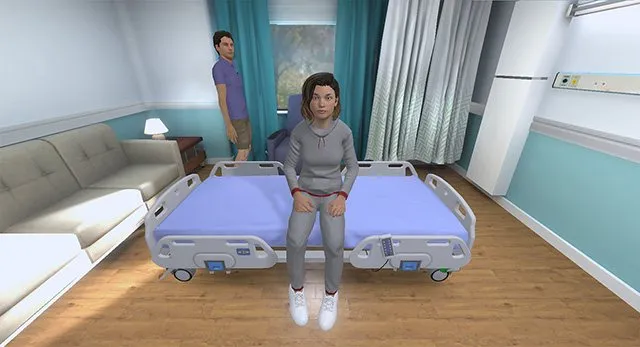
Built for clinical and pre-hospital care
A ready library of patient cases for nursing schools, ambulance services and hospitals, each one duplicable and editable to match your own protocols.
Does it need a headset? Not always
Start in the browser, add headsets later
This is the part that matters most for teams working to a tight budget. A nursing college or an EMS academy can start using VR Patients without buying a room full of expensive headsets first. Train on the computers you already have, then add headsets for the fully immersive version if and when the budget allows.
- Runs in any web browser, no headset required
- On a headset, optimised for Meta Quest 3, Meta Quest 3s and HTC VIVE XR Elite
- Standard, widely available headsets, not custom hardware
- Cloud based, with round-the-clock access so trainees practise on their own schedule
- Sold on subscription, per seat or licence, so it scales with your programme

Your educator stays the expert
Build your own case in about 30 minutes, no coding
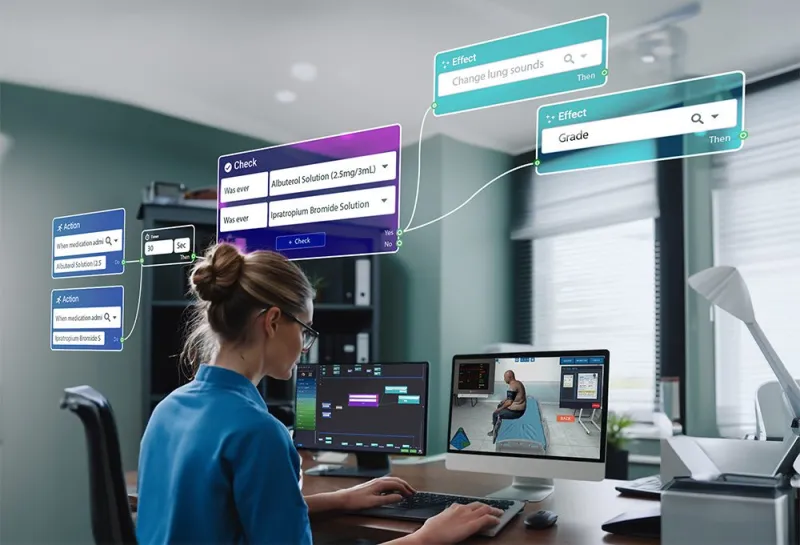
The scenario builder is no-code, which simply means you do not need any programming skill to use it. Instructors work through a visual, node-based flow: they connect building blocks on screen to map how the patient responds to each decision. Set a learning objective, choose the patient and setting, add the assessments and treatments, and decide how the condition changes.
When a scenario ends, VR Patients grades the encounter and walks the trainee through what happened and why, adapting the debrief to the decisions they actually made. That after-action review is where a lot of the real learning happens, and it is where your educator does their best work. The platform runs the repetitions and the detail; your instructor turns them into real learning.
Who it is for
Built for the teams who care for patients under pressure
Nursing programmes and schools
Give every student repeated, hands-on patient encounters that a real ward placement could never guarantee, and build clinical judgement in a safe setting.
EMS and ambulance services
Let paramedics and EMTs rehearse emergency calls, from cardiac events to trauma, as often as they need, without waiting for the right real case.
Medical schools
Add realistic patient assessment and decision-making practice alongside traditional teaching, so students arrive on placement already sharp.
Hospitals and health systems
Keep clinical teams current with repeatable scenarios and clear after-action review, on a schedule that fits shift work.
Military and defence medical units
Train medical readiness and emergency response where live practice is difficult or hazardous to stage.
Universities and colleges
Subscription is per seat, so it scales cleanly from a single cohort to a whole faculty.
Product sheets
Download the VR Patients product sheets
Detailed product sheets for each VR Patients configuration, from web and headset delivery to tailored services. Open any of them as a PDF.
See a virtual patient for yourself
Step into a scenario
The quickest way to understand VR Patients is to watch a scenario play out. Book a demo and we will walk you through a live patient case, show you how an instructor builds one from scratch, and help you work out whether to start in the browser or go straight to headsets. No obligation, just an honest look at what your clinical training could become.
Frequently asked questions
What is VR Patients?
VR Patients is an AI-driven medical simulation platform for training nurses, paramedics and other clinicians. It puts a lifelike virtual patient in front of the trainee, who assesses, treats and talks to that patient as they would in a real ward or ambulance. It ships with 85 ready-built patient cases, lets instructors build their own, and is made in the United States. SkillsTrain supplies VR Patients across South Africa and Southern Africa. AI here means artificial intelligence, software that lets the virtual patient understand and respond to the trainee naturally.
Do I need a VR headset to use VR Patients?
No. You can use a VR headset, but you do not have to. VR Patients also runs in an ordinary web browser on the laptops and desktops you already have, which makes it a practical starting point for teams that do not want to buy headsets first. On a headset it is optimised for Meta Quest 3, Meta Quest 3s and HTC VIVE XR Elite.
Can VR Patients help with mental-health and wellness cases?
Yes. VR Patients scenarios can include difficult conversations around low mood and mental wellbeing. Its AI-driven patients will talk through issues like falls, memory loss, depression and medication, so clinicians practise the conversation, not just the clinical steps.
Can instructors build their own scenarios?
Yes. VR Patients includes a no-code scenario builder, which means no programming skill is needed. Instructors work through a visual, node-based flow: they set a learning objective, choose the patient and setting, add the clinical assessments and treatments, and decide how the patient responds to each decision. Instructors report building a custom case in about 30 minutes. Every one of the 85 pre-loaded cases can also be duplicated and edited to match your own protocols.
How many patient scenarios come with VR Patients?
It comes with 85 pre-loaded patient scenarios, with nearly 40 more scheduled to arrive during 2026 (VR Patients, reported by EMS1, March 2026). Instructors can also build unlimited scenarios of their own with the no-code builder.
How is VR Patients sold?
VR Patients is sold on a subscription basis, with access per seat or licence, so it scales with the size of your programme, from a single cohort to a whole faculty. Phone Linda at SkillsTrain for a quote that fits your team.
VR Patients is made in the United States. SkillsTrain is the Southern African supplier: we distribute and support the platform. The training itself is delivered by the accredited organisations that use it.
Not sure which platform fits your team? See our vendor-neutral VR and simulation buyer's guide.